Biohackers call it a healing peptide, scientists call it experimental. What BPC-157 is, how it may work, and what we know about its benefits, risks and legal status in 2026.


Elena Brull
Women's Health & Functional Nutrition Research Writer · November 18, 2026 · 10 min read
Introduction
You may have heard BPC-157 called a “healing peptide” or even the “Wolverine peptide”: on podcasts, in biohacking forums, on Instagram.[1] Its story began far more quietly, with one of the toughest jobs in the human body: protecting the stomach from its own acid.
Every day, your stomach produces acid strong enough to break down the food you eat. So why doesn't it digest itself? In the late 1980s, researchers in Zagreb, Croatia, went looking for the substances that help the stomach protect itself. What they found, and what they later recreated in the lab, became BPC-157.
This is Part 1 of our BPC-157 series. Before we talk about treatments, we start where the science started.
How Does the Stomach Protect Itself?
Your stomach produces hydrochloric acid and enzymes that break down the proteins in your food. Yet the stomach wall is made largely of protein itself, and under normal conditions it stays intact.
Several layers of protection make this possible. A thick layer of mucus covers the lining like a shield. Cells beneath it release bicarbonate, which neutralizes acid right at the surface. A dense network of tiny blood vessels supplies the lining with oxygen and nutrients.[6] And the surface cells are replaced every few days, so small injuries heal before they become a problem.[7]
If this protection weakens, the lining can become inflamed and ulcers can form. A familiar cause is ibuprofen, which many women take for period pain. It lowers prostaglandins, messenger substances the lining needs to produce mucus and bicarbonate, and when taken over weeks or months it can damage the stomach.[6][8]
Scientists wanted to know which substances keep this protection working, and whether they could also protect other tissues.
Where Does BPC-157 Come From?
In the late 1980s, researchers in Zagreb, Croatia, set out to answer that question. In a patent application from 1989, they described a protective substance they had extracted from the gastric juice of 542 patients. They named it BPC, short for Body Protection Compound.[9]
BPC itself was a large protein. The researchers, led by Predrag Sikirić at the University of Zagreb, then focused on a small piece of it: a chain of just 15 amino acids that they believed was essential for its protective effect. In 1993, they published their first paper on this fragment. They called it BPC 157.[10] The original patent already lists the first 15 building blocks of BPC, and they match the sequence later known as BPC-157.[9]
What Does BPC-157 Mean, and Is It Natural?
To understand BPC-157, it helps to think of amino acids as letters. Arrange them in a certain order, and you get a word. Arrange them differently, and you get a different word with a different meaning.
In the body, many peptides work as messages. Insulin is a well-known example. Cells “read” these messages through docking sites on their surface, called receptors, which fit a specific peptide the way a lock fits a key. Once the message is received, the cell responds.
The BPC-157 used in research does not come from gastric juice. Chemists assemble it in the lab, one amino acid at a time. This gives scientists a pure, precisely defined substance they can test in experiments.
Many websites, and even some scientific papers, say that BPC-157 was “isolated from human gastric juice.”[12] Strictly speaking, that isn't accurate. What researchers isolated was the larger protein BPC. BPC-157 is a fragment of it, recreated in the lab. Whether this exact 15-amino-acid chain occurs on its own in the human body, and what it might do there, has never been clearly shown.
The distinction matters because “natural” is often used as a selling point. The effects scientists have observed come from experiments with the lab-made peptide, mostly in animals. They tell us what BPC-157 can do under test conditions, not what it does naturally in your body.
Why Did Scientists Become Interested in BPC-157?
Most peptides don't last long in the stomach. The same acid and enzymes that break down food also break down small protein chains. BPC-157 appeared to be an exception. According to the Zagreb researchers, it stays intact in human gastric juice for more than 24 hours.[13] This finding comes from the research group itself and has not been independently confirmed, but it explains why the peptide caught their attention.
The first experiments stayed close to its origin. In rats, the researchers tested whether BPC-157 could protect the stomach lining from damage caused by stress, alcohol and painkillers of the same class as ibuprofen.[14]
From there, the team developed a broader idea. If the stomach makes substances that protect it, perhaps these substances could protect other organs, too. They saw BPC as a possible natural messenger of this protection.[10] As early as 1993, they also tested BPC-157 on liver damage in rats.[15]
Later, tendons came into focus. Many tendons have a relatively poor blood supply, so they receive little oxygen and few nutrients, and they heal slowly.[12] Keen runners know how frustrating an irritated Achilles tendon can be, and tennis elbow can make even lifting a coffee cup painful. Both can keep you from exercising for weeks. If BPC-157 helped form new blood vessels, slow-healing tissues like these were where it might make the biggest difference.[16]
How Is BPC-157 Thought to Work?
Almost everything we know about how BPC-157 might work comes from studies in animals and in cells grown in the lab. The exact mechanism has not been fully worked out. With that in mind, the findings can be grouped along the three phases of healing.[12][17] These phases overlap, and their length differs from tissue to tissue, so treat the days below as a rough guide.
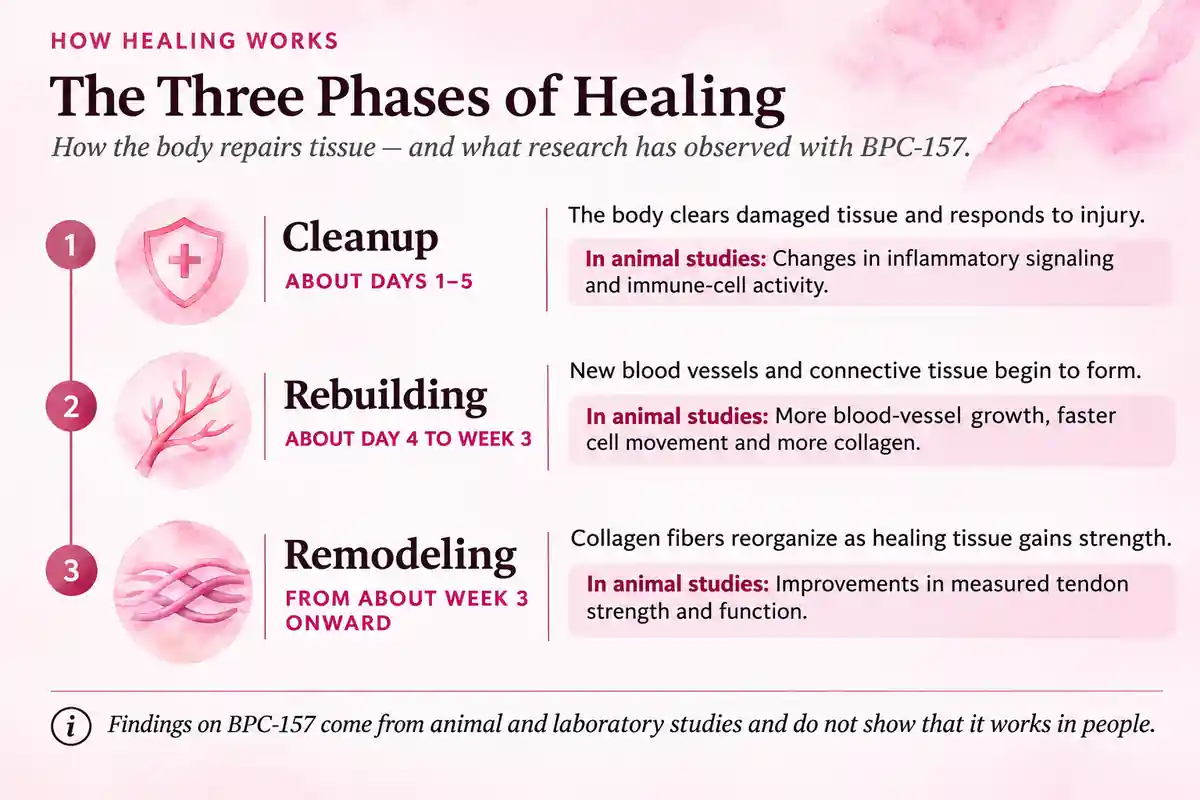
Phase 1: Cleanup (about days 1 to 5). After an injury, immune cells move in to clear away damaged tissue and germs. You can see and feel this phase: the area turns red, feels warm, swells and hurts. These signs usually peak after two or three days and then fade. Inflammation is useful at the start, but if it lingers, it slows healing. In animal studies, BPC-157 lowered the levels of several inflammatory messengers, and in some studies scavenger cells switched more quickly from clearing out damage to supporting repair.
Phase 2: Rebuilding (about day 4 to week 3). The body now fills the gap with new tissue. For this, it needs oxygen and nutrients, delivered through new tiny blood vessels. On a skin wound, you see the edges pulling together and fresh pink tissue forming. With a sprained ankle or a sore tendon, the swelling goes down and everyday movement gets easier, although the area is still fragile. In animal studies, BPC-157 encouraged the growth of new blood vessels, partly, researchers think, through nitric oxide, a gas the body uses to widen blood vessels. Nitric oxide also helps protect the stomach lining, which links this finding back to where the research began.[6] Connective tissue cells moved into the injured area faster and produced more collagen, the protein that gives skin and tendons their strength.
Phase 3: Remodeling (from about week 3, often for months). At first, the new collagen is laid down quickly and somewhat randomly, like a hasty patch. Over time, the fibers mature and line up along the direction of pull, and the tissue grows stronger. You notice this when a scar slowly fades from red to pale and flattens, or when a tendon gradually tolerates running again. An injury can therefore feel healed long before the tissue is fully resilient. In animal tendon studies, tendons treated with BPC-157 were stronger and worked better.
One observation puzzles researchers. In animal studies, the body broke down BPC-157 in less than 30 minutes, yet researchers could still measure some of its effects on healing tissue weeks later. Researchers suspect that it works like a switch, as if it delivered a message to regenerate. They have observed changes in gene activity shortly after treatment, but they do not yet understand how these changes lead to effects that last for weeks. It is also unknown which receptor reads this message, because no docking site for BPC-157 has been identified so far.[12]
Thirty Years Later: Where Does the Research Stand?
Since the first paper in 1993, hundreds of publications on BPC-157 have appeared.[19] Almost all of the studies were done in animals or in cells in the lab. Most come from a single source. In a 2025 scientific commentary, researchers reported that more than 80 percent of the BPC-157 articles in the medical database PubMed named Predrag Sikirić or his Zagreb colleague Sven Seiwerth as lead or senior authors.[20]
In humans, the picture is very different. A 2026 review of the research found only three human studies that met its criteria, with 30 participants in total.[4] Earlier studies in people, mainly on inflammatory bowel disease in Croatia in the early 2000s, also exist, but none has shown that BPC-157 works.[12][21] None of the three compared BPC-157 with a placebo or with patients who received no treatment. Researchers have also noted that the published studies on BPC-157 report only positive effects, which can be a sign that negative results never made it into print.[12]
In two of them, patients with chronic knee pain or a painful bladder condition called interstitial cystitis reported that their symptoms improved.[28][29] The third tested the safety of BPC-157 given into a vein in two healthy volunteers.[30] There are no published human studies on skin aging or hair loss. We take a closer look at what these studies found, and what they leave open, in Part 4.
Why are there so few human studies?
One likely reason is money: large clinical trials cost millions. Companies usually fund them only if they can later sell the drug exclusively, and the basic BPC-157 peptide has been publicly known for decades. This can create a vicious circle. Without funding there are no trials, and without trials there is no solid evidence that might attract funding.
There have been attempts. In the early 2000s, BPC-157 was developed under the name PL 14736 as a possible treatment for inflammatory bowel disease.[21] In 2015, a safety study in healthy volunteers was registered. Its results have never been published.[22]
What is changing now
In February 2026, the first randomized, placebo-controlled trial of BPC-157 began. It aims to enroll 120 adults with a strained hamstring muscle at a hospital in Shenzhen, China. Half receive BPC-157, the other half a placebo, and neither the participants nor the researchers know who gets what. The researchers plan to complete the main analysis in early 2027.[5]
The lack of human studies does not show that BPC-157 is ineffective, but it also gives no proof that it works in people. Only trials like this one can answer that question.
Approved, banned or tolerated?
For drugs that pharmacies prepare themselves, the FDA sorts ingredients into groups: those it tolerates while it reviews them, and those it blocks because of safety concerns.[23] BPC-157 has moved between these groups. In 2023, the FDA put it on the list of substances that may not be compounded. In April 2026, it was taken off that list, and in July an FDA advisory committee voted 8 to 6 in its favor, against the recommendation of the FDA's own reviewers.[24] In October, the Department of Health and Human Services (HHS) announced that it would not take action against pharmacies compounding BPC-157 while the FDA completes its formal review.[2] BPC-157 is therefore neither approved nor blocked. It is tolerated, but only under conditions. The policy covers one form of the peptide, called BPC-157 acetate, given as an injection under the skin or into a muscle, taken by mouth or applied to the skin. It also sets rules for product quality. Not every product sold as BPC-157 is covered, and the policy says nothing about whether BPC-157 is safe or effective. What these different forms mean, and how products from licensed pharmacies differ from so-called research peptides sold online, is the subject of Part 3.
HHS gave two reasons for this step. First, patients should have better access to these peptides while the FDA reviews them. Second, the policy is meant to steer people away from so-called research peptides, often made by foreign manufacturers and sold online, which HHS considers a safety risk.[2] Observers have described this as harm reduction. The idea is that people who use BPC-157 anyway are safer with a controlled product from a licensed pharmacy.[25] Critics objected that the evidence of safety is still too thin.[26]
One rule remains in place. Pharmacies may only hand out compounded BPC-157 to a patient who has a valid prescription. The reason lies in US drug law. Compounded medicines do not go through the FDA's approval process, and lawmakers allowed this exception only for medicines prepared for one individual patient, not for mass production.[27] Prescriptions may be written by licensed physicians or by other health professionals who are allowed to prescribe medicines under the law of their state. They decide whether the possible benefit outweighs the uncertainties for this particular person, and they are responsible for that decision.
After more than 30 years of research, scientists know exactly how to spell BPC-157. What this word means to the human body is still an open question.
Medical & Editorial Disclaimer
Content published by BeMediq Journal is provided for educational and informational purposes only. It may discuss scientific research, health, wellness, aging, beauty, lifestyle, and related topics, but is not intended to provide medical advice, diagnosis, or treatment, or to replace consultation with a qualified healthcare professional.
Scientific evidence evolves, and research findings may be preliminary, observational, conflicting, or subject to different interpretations. References to studies, biological mechanisms, associations, or potential benefits should not be understood as establishing that the same findings apply to every individual or as demonstrating clinical effectiveness unless specifically supported by the evidence discussed.
Editorial analysis, interpretations, perspectives, and opinions presented by BeMediq Journal are intended to provide context and encourage informed discussion. Where scientific evidence and editorial interpretation intersect, we aim to distinguish established findings from emerging evidence, hypotheses, and our editorial perspective.
Decisions concerning your health, medications, treatments, supplements, or other medical care should be made in consultation with an appropriately qualified healthcare professional.
Written by Elena Brull, Women’s Health & Functional Nutrition Research Writer (ORCID: 0009-0009-3547-6731)
About the Author
Elena Brull is a Women’s Health and Functional Nutrition Research Writer covering women’s health, nutrition, metabolic health, hormonal transitions, and longevity. Her work examines scientific research, emerging evidence, and the connections between them to help women better understand their biology and the questions worth asking about it. She writes from a non-clinical, educational perspective — with the intention to inform and empower, not to diagnose or prescribe.
Our Editorial Standards
License:
© 2026 BeMediq.
This article is published under a Creative Commons Attribution–NonCommercial–NoDerivatives 4.0 International License (CC BY-NC-ND 4.0).
Educational sharing is permitted; commercial use or modification requires written permission from the author and BeMediq.
EDITORIAL DISCLOSURE
BeMediq Care offers products or services related to the topic discussed in this article. BeMediq Journal evaluates the scientific evidence independently of products and services offered through BeMediq Care. Research discussed here should not be interpreted as evidence that a specific BeMediq product or service produces the same effects unless explicitly stated and supported by evidence specific to that product or service.
────────────
FROM BEMEDIQ CARE · COMMERCIAL
Explore BeMediq Care
BeMediq Care offers access to health and wellness services separate from the editorial content of BeMediq Journal.
Discover Products to Support Your Health & Well-Being
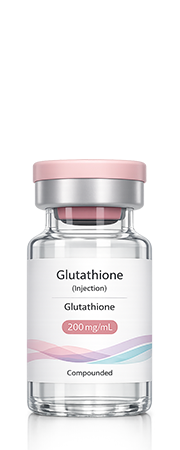
Glutathione Injection
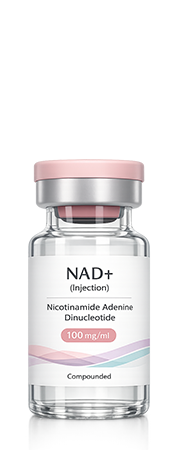
NAD+ Injection
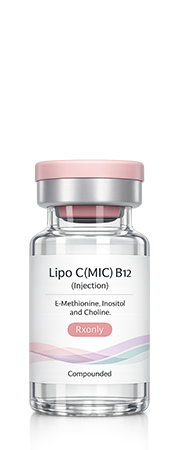
MIC+B12 Injection
GLP-1 Weight Loss Program

BiEst 50:50 Balance
Science Spotlight
Curious About the Science behind this Article?