

The GLP-1 Skin Paradox: Why Skin Changes Can Look So Different
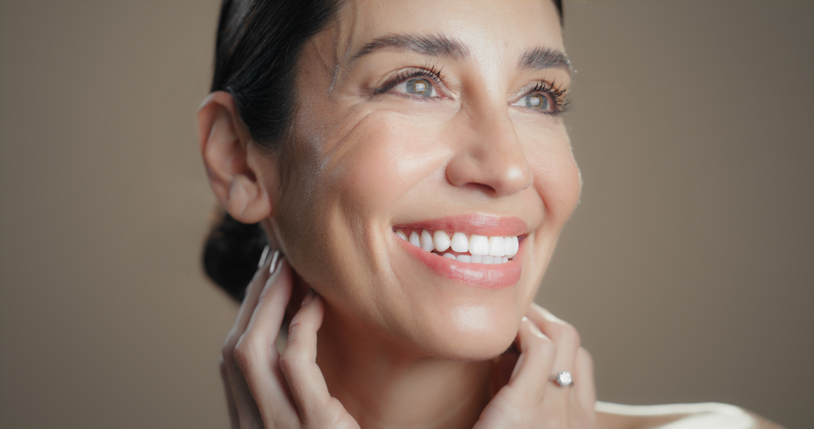
First came the images: hollowed cheeks, looser skin, a face that seemed to have aged faster than expected after substantial weight loss.
Soon, it had a name.
“Ozempic face.”
The phrase became shorthand for one of the most visible fears surrounding GLP-1 medications: that losing weight might also mean losing some of the fullness that once supported the face, making lines and laxity more noticeable.[1]
And facial changes are not the only concerns people have described. Dryness, itching, acne, rashes and even unusual sensations such as burning skin have all entered the conversation around GLP-1 therapy.[1,2]
Yet the research tells a more complicated story.
Skin Changes During GLP-1 Therapy: Beyond “Ozempic Face”
While much of the conversation around GLP-1 therapy has focused on the loss of facial fullness and the more visible lines and laxity that can come with it, some studies have documented changes within the skin that point in another direction.
And these observations were not simply about appearance. Researchers were looking at acne and inflammatory skin conditions such as hidradenitis suppurativa and psoriasis, as well as wound healing in people with diabetes. These are health problems that can significantly affect quality of life and, in some cases, occur alongside obesity and metabolic disease.[1,3–6]
What they observed was unexpected.
Over two years of semaglutide treatment, researchers watched acne become less severe and the skin produce less sebum. At the same time, weight, glucose regulation and other metabolic markers improved.[3]
Across several observational studies, researchers have documented signals of lower inflammatory activity and improvements in inflammatory skin conditions during GLP-1 therapy.[1,4]
In people living with hidradenitis suppurativa — a chronic inflammatory skin condition that can cause painful lumps and lesions — researchers observed something similar. During six months of semaglutide treatment, the skin condition became less severe and pain decreased. At the same time, participants lost weight, their metabolic health improved and inflammatory markers fell.[4]
The study also opens another perspective: weight management itself may matter for the health of our skin. Obesity is closely associated with hidradenitis suppurativa, which makes it difficult to separate the effects of the medication from those of weight loss. But even when the researchers accounted for weight loss, some of the changes remained, suggesting that weight loss may not be the whole story.[4]
Researchers found similar clues in people with psoriasis.
In small studies, they observed that psoriasis improved during GLP-1 therapy.[1] But here, the evidence becomes less clear. In a randomized placebo-controlled trial, liraglutide did not significantly improve psoriasis compared with placebo.[5]
Alongside these observations of changes in the skin itself, another potential benefit has emerged: better wound healing.
For people with diabetes, that possibility is particularly meaningful. Diabetes can make wounds more difficult to heal, and foot ulcers can become serious complications.
In a large retrospective analysis of people with diabetes-related foot ulcers, those taking semaglutide experienced fewer wound-related complications.[6] And the clinical observation is not entirely isolated: experimental research has also found signs that GLP-1-based compounds may influence skin cells and biological processes involved in repairing damaged tissue.[1,6]
We still have to be careful about what those findings mean. The clinical study was observational, so it cannot tell us whether semaglutide itself was responsible for the better outcomes. But it adds another unexpected observation to a picture that is becoming increasingly difficult to describe as simply “good” or “bad” for our skin.
When we compare these observations — less acne and sebum, lower inflammatory disease activity in some patients, and possible improvements in wound healing — a very different picture begins to emerge.
The public narrative of GLP-1 therapy making our skin look “worse” does not sit easily alongside clinical observations of less acne, lower inflammatory activity and better wound healing.
Instead, the evidence points toward a more complex possibility: GLP-1 therapy may, in some circumstances, coincide with lower inflammatory activity or improvements in particular skin conditions — while at the same time producing, or accompanying, visible changes that people perceive as signs of accelerated aging.
Perhaps it isn’t a contradiction at all.
“Ozempic face” and changes within the skin itself are not necessarily the same phenomenon.
The hollowing and greater visibility of lines associated with “Ozempic face” are largely understood as consequences of substantial, often rapid weight loss and the accompanying loss of facial fat.[1] The face may therefore look older without the medication necessarily having made the skin itself more inflamed or biologically “older.”
Changes such as dryness, itching, burning sensations, acne, sebum production or inflammatory skin disease are different. They concern what may be happening within the skin itself: its barrier, inflammatory environment, sebaceous activity and sensory responses.
And here, the picture is much less straightforward.
Clinical studies can measure acne, sebum or inflammatory activity. But not every change in our skin fits neatly into a clinical measure.
Some people taking GLP-1 medications describe something much simpler: their skin just looks better. Clearer. Calmer. Healthier. Some even describe it as younger-looking or rejuvenated.
Those perceptions are not proof that GLP-1 medications rejuvenate the skin. But they take on new meaning when placed beside clinical observations of lower acne severity, reduced sebaceous activity and reduced inflammatory disease activity in some studies.[3,4]
Looking older and having healthier-functioning skin are not necessarily the same thing.
The emerging picture becomes even more interesting when we consider a very different kind of response to GLP-1 therapy: body odor.
Body odor is not simply something that happens around our skin. It is closely connected to its biology. Sweat and other skin secretions interact with microorganisms living on the skin, helping create the odors we ultimately perceive.[8]
That makes one unusual case particularly interesting. In 2026, physicians described a man who developed an unpleasant body odor shortly after starting dulaglutide. The odor disappeared when the medication was stopped, returned when it was restarted, and did not return after he switched to semaglutide.[7]
One case cannot tell us why this happened or whether GLP-1 therapy altered sweat, skin secretions, the skin microbiome or something else entirely. But it gives us two intriguing details: the response appeared in one particular person, and it changed when the medication changed.
Together with the very different skin observations we have already seen, that brings us to a larger question.
Why Can GLP-1 Therapy Affect Our Skin So Differently?
Weight loss may explain some of what we observe. But it does not necessarily explain the full range of skin changes reported during GLP-1 therapy.
The answer may not lie in one factor alone.
We are not actually talking about one medication, but several different ones. And they are not entering identical bodies. Each person brings a different biological starting point.
Two people can meet the same criteria for GLP-1-based weight treatment and still arrive there through very different biological circumstances. Their glucose regulation, hormonal environment, thyroid function, body composition, diet and gut microbiome may differ — as may the biology of their skin.[9,10]
These are not isolated compartments. Metabolism, hormones, immune signaling, the gut and the skin are connected through overlapping biological pathways. A change in one does not automatically cause a change in another, but neither does it occur in complete isolation.[11,12]
GLP-1-based therapies therefore introduce a similar pharmacological signal into biological environments that may already be very different.
The medication may be the same. The biology it enters is not.
For women in perimenopause, for example, changing estrogen signaling may influence insulin sensitivity, glucose regulation and fat distribution — one example of how the biology behind changes in weight and metabolism can shift across life.[13,14]
Whether those differences help explain the very different skin responses observed during treatment remains an open question.