01
The Skin Microbiome: Healthy Skin Was Never Sterile
For much of modern medical history, microorganisms on the skin were
viewed primarily through the lens of infection.
Bacteria were something to remove. Sterility was associated with
cleanliness. And when scientists wanted to know which microorganisms
lived on human skin, they usually had to grow them in the laboratory.
That created an important limitation.
Not every microorganism living on the skin can be easily cultured.
[3]
So the microbial world scientists could grow in a laboratory represented
only part of what was actually there.
Then DNA Changed What We Could See
Advances in DNA sequencing transformed the field.
Instead of asking only:
Which microorganisms can we grow from the skin?
researchers could increasingly ask:
Which microbial DNA can we detect there?
Techniques such as 16S ribosomal RNA sequencing made it possible to
identify bacterial communities without first having to culture every
organism. [1,3]
In 2009, researchers from the National Institutes of Health examined
bacterial communities across 20 distinct skin sites
in healthy adults. The study revealed a microbial landscape far more
diverse and complex than culture-based methods had suggested.
[1]
Healthy skin was not sterile.
It was inhabited.
And once scientists began looking at skin this way, another discovery
became impossible to ignore:
these microbial communities were not distributed evenly across the body.
[1]
Where on the skin researchers looked mattered.
From Presence to Relationship
Finding microorganisms on healthy skin tells us
who is there.
It does not yet tell us what they are doing.
This is where the concept of the microbiome became more important than
simply compiling a list of microbes. Researchers increasingly began to
investigate microorganisms as communities — and the relationships they
form with the skin and with one another. [3,4]
The scientific question began to shift from:
Which microbes live on skin?
to:
What kind of ecosystem do they form with us?
That ecosystem also has a geography of its own.
02
Why the Skin Microbiome Differs Across the Body
The skin may look like one continuous surface.
Microbiologically, it is not.
Different parts of the body create remarkably different environments
for microbial life.
Scientists commonly describe skin sites as
sebaceous, moist or dry. Each provides different
ecological conditions, and each tends to support a characteristic
microbial community. [1,3]
This means that microorganisms found on the forehead, for example,
do not necessarily occur in the same proportions as those found on
the forearm or in a skin fold. [1,3]
Microbial geography follows the environment of the skin,
not simply the map of the body.
And There Is Another Layer: You
Location is only part of the story.
Skin microbial communities also differ between individuals.
[2,3]
Despite constant contact with clothing, water, other people and the
environment, parts of an individual's skin microbiome can remain
surprisingly stable over time. [2]
The skin microbiome therefore carries both a geography of the body
and characteristics of the individual.
Where microorganisms live matters. So does the skin they inhabit.
But these habitats are not fixed. The biology of our skin changes
with us — and hormones are one reason why.
03
How Hormones Shape the Skin Microbiome Across a Woman’s Life
The microbial world on our skin does not remain the same throughout life.
One reason is that the skin itself changes with us.
Hormones can influence sebaceous activity, skin lipids, barrier
function and immune signaling — all of which help shape the
environment in which microorganisms live. [3]
Puberty provided researchers with one of the clearest examples.
As sebaceous activity increases, lipid-associated microorganisms such
as Cutibacterium and Malassezia become more prominent
at particular skin sites. [3]
Cutibacterium is a genus of bacteria commonly found in
sebaceous areas and hair follicles, while Malassezia are
lipid-dependent yeasts that normally inhabit areas such as the scalp,
face and upper trunk.
Both are normal inhabitants of healthy skin. But under certain
conditions, changes in their abundance and behavior can contribute
to skin problems — Cutibacterium acnes, for example, is
involved in the biology of acne. [3,15]
The importance of puberty to this story is not puberty itself.
It is what it revealed:
When hormones alter skin physiology, the microbial habitat can change with it.
The Microbiome in Midlife
A woman’s hormonal story continues to evolve throughout her life —
and midlife opens a new chapter.
During perimenopause, hormonal patterns begin to shift, eventually
giving way to menopause and the postmenopausal years. These transitions
affect the skin too. Changes in sebum, hydration, barrier biology and
other characteristics of skin raise an intriguing question:
Does the microbial ecosystem living on our skin change with us?
Science is only beginning to answer it.
A 2024 pilot study found differences between pre- and postmenopausal
facial microbiomes, including lower relative abundance of
Cutibacterium and greater bacterial diversity after menopause.
[5]
The evidence for perimenopause itself is even more limited.
Menopause and chronological aging occur together, making their individual
contributions difficult to separate. [5]
We know much more about how the skin microbiome changes during puberty
than we do about what happens during the hormonal transition of midlife.
[3,5]
What current research suggests is a broader principle: hormones can
change the biology of the skin, and changes in skin biology can alter
the habitat available to microorganisms. [3,5]
Hormones may originate within us, but some of their effects become
ecological conditions on our skin.
And that brings us to the habitat itself.
04
How pH, Sebum and Moisture Shape the Skin Microbiome
If microorganisms inhabit our skin, what determines where they thrive?
Part of the answer lies in the skin itself.
pH, sebum and moisture are not simply characteristics of our skin.
For microorganisms, they are environmental conditions. [3,6]
The Skin Surface Has Its Own Chemistry
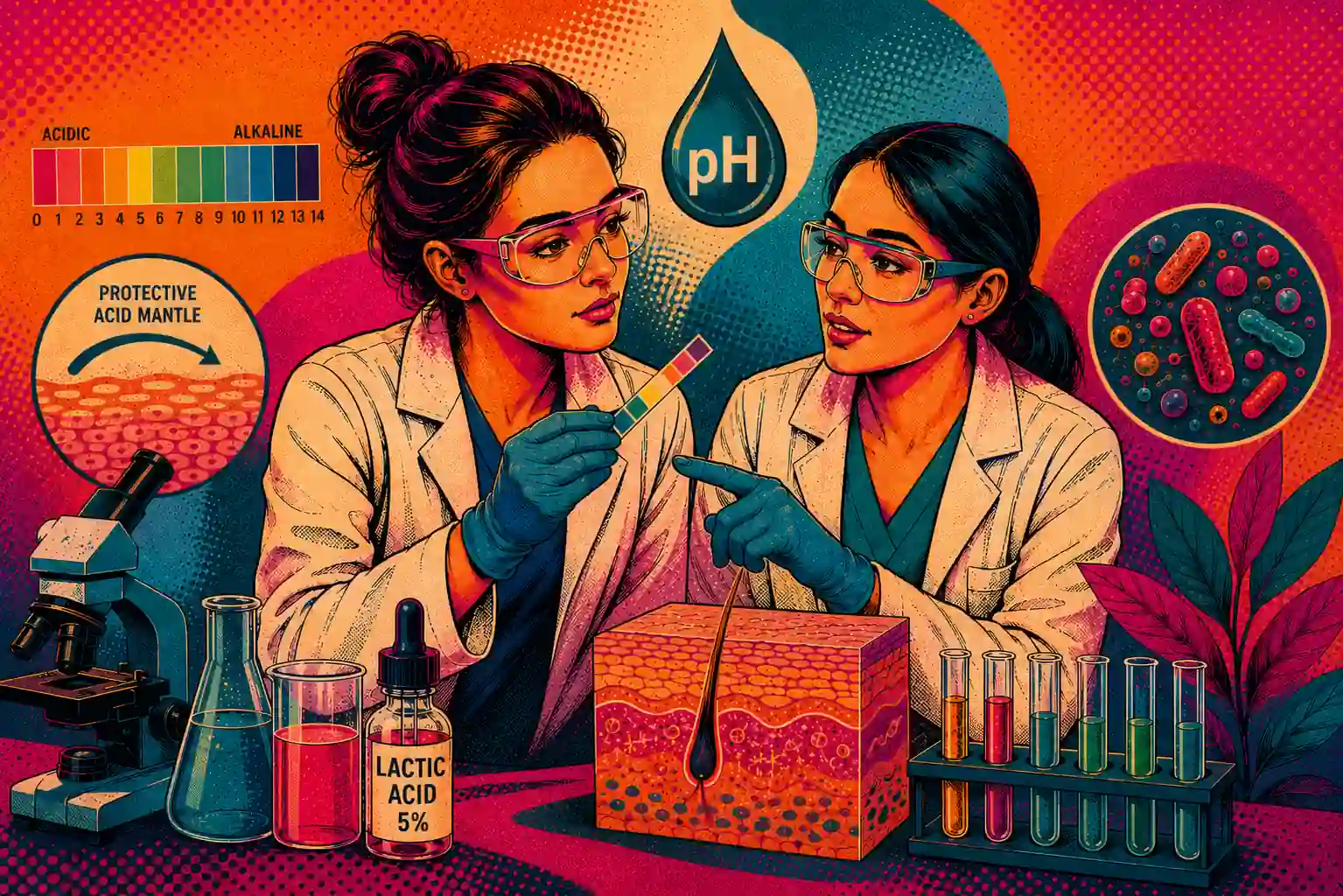
Healthy skin generally maintains a mildly acidic surface environment,
often described as the acid mantle. Skin surface pH
varies considerably, but on many areas of healthy adult skin it is
typically around 4.5 to 5.5. [6,7]
This acidity contributes to barrier function and helps shape the
conditions in which microorganisms live. [6,7]
The important point is not that every pH above 5.5 is automatically
unhealthy. Skin pH varies naturally. [6]
When the skin becomes less acidic, both barrier biology and the
microbial habitat can change. [6]
Skin pH may also influence the microbial environment involved in
body odor. [6]
Body odor itself arises when skin microorganisms transform components
of sweat into odor-producing compounds. [8]
Sebum adds lipids to this environment, while sweat and moisture alter
water availability, salts and other conditions at the skin surface.
[3]
Together, these factors help create the different microbial habitats
we encountered earlier in this article.
Microorganisms are not passive inhabitants of this environment.
They can metabolize substances found on the skin and produce compounds
that become part of its local chemistry. [3,4]
The skin helps create the microbial habitat — and its microorganisms
help shape it in return.
But chemistry is only part of the relationship. The skin must coexist
with enormous numbers of microorganisms while remaining capable of
responding when something poses a threat.
That relationship also involves the immune system.
05
How the Skin Microbiome and Immune System Communicate
The skin is home to enormous numbers of microorganisms. Yet most of
the time, their presence does not trigger an inflammatory response.
[4,9]
That tells us something important.
The immune system does more than defend the skin against microbes.
It also helps determine how we coexist with them. [4,9]
Defense Is Only Part of the Story
Skin cells can recognize microbial signals and respond by producing
antimicrobial peptides, cytokines and other molecules involved in
immune defense. [4,9]
But resident microorganisms are not passive in this relationship.
Some commensal microbes can help limit the growth of potential
pathogens, influence antimicrobial defenses and interact with immune
cells in ways that contribute to skin homeostasis. Research on
Staphylococcus epidermidis — a common resident of healthy
skin — has helped reveal just how complex these relationships can be.
[4,9]
Healthy skin does not achieve protection by eliminating microbial life.
It maintains a relationship with it.
And that relationship works in both directions: the immune system helps
shape which microorganisms can persist on skin, while microbial signals
and metabolites can influence how the skin's immune system responds.
[4,9,10]
The microbiome is therefore not separate from the skin's defenses.
It is part of an ongoing exchange.
06
Diabetes, Prediabetes and the Skin Microbiome: What Do We Know?
The microbial habitat of our skin is shaped not only by what happens
at the surface.
Metabolic health may matter too.
Diabetes changes more than blood glucose. Changes in immune function,
circulation and skin physiology can also alter the environment in which
microorganisms live. [11–13]
Researchers have therefore begun to ask whether diabetes is reflected
in the skin microbiome.
What Diabetes Research Shows
Studies in people with type 2 diabetes have identified differences
in skin microbial communities, although much of the research has
focused on the feet and diabetes-related skin complications.
[11–13]
There is not yet one universal “diabetic skin microbiome.”
[11–13]
Researchers are still working to separate the effects of metabolic
disease itself from the many physiological changes that can accompany
diabetes.
Nevertheless, the broader finding is important:
A systemic metabolic condition can be accompanied by changes in the
microbial ecosystem of the skin. [11–13]
What About Prediabetes and Insulin Resistance?
This is where the map becomes much less complete.
The relationship between insulin resistance, prediabetes and the
gut microbiome has been studied much more extensively
than corresponding changes in the skin microbiome.
[17] Direct evidence for changes in the
skin microbiome before diabetes develops remains limited.
Whether changes in the skin microbiome begin during insulin resistance
or prediabetes — before type 2 diabetes develops — remains an open question.
Diabetes has given researchers evidence that metabolic disease and skin
microbial ecology can intersect. [11–13]
How early that relationship begins is something we still do not know.
07
The Gut–Skin Axis: How Diet and the Gut Microbiome May Influence Skin
The skin microbiome may seem like a world of its own.
But increasingly, researchers are asking whether it is connected
to another microbial ecosystem: the gut microbiome.
This emerging relationship is known as the
gut–skin axis. [14]
Two Microbial Worlds, One Body
The gut and skin are physically distant, but they are connected through
the biology between them.
Microorganisms in the gut produce metabolites and interact with the
immune system. Through these and other pathways, activity in the gut
may influence biological processes far beyond the intestine — including
the skin. [14]
Researchers have found associations between the gut microbiome and a
range of skin conditions, although these relationships do not by
themselves establish cause and effect. [14]
Where Diet Enters the Story
Diet is one of the factors capable of influencing the gut microbiome.
[14]
Diet may influence skin through nutrients and metabolism directly,
while also shaping microbial activity in the gut. [14]
That makes the relationship between diet, gut microbes and skin
particularly interesting — but also difficult to simplify.
The evidence is not yet strong enough to define one diet that creates
a “healthy” skin microbiome. [14]
The gut–skin axis suggests that the microbial world on our skin may
be influenced by processes taking place far beyond its surface. [14]
08
Skin Dysbiosis: Why “Good” and “Bad” Bacteria Are Too Simple
As microbiome science entered skincare, a simple idea became increasingly
common: healthy skin has “good” bacteria, while skin problems appear
when “bad” bacteria take over.
The biology is more complicated. [3,4,15,16]
When the Ecosystem Shifts
Dysbiosis describes a disruption or shift in a microbial
community that is associated with a change in its relationship with the
host. [3,15]
Acne offers a useful example.
Cutibacterium acnes is also a common resident of healthy skin.
Acne is therefore not simply a story of a “bad” bacterium appearing
where it should not. [15]
Particular strains, the follicular environment and interactions with
the immune system can all influence its behavior. [15]
The same principle applies to other common residents such as
Staphylococcus epidermidis: different strains and biological
contexts can produce different relationships with the skin.
[16]
A microorganism is not inherently “good” or “bad” simply because
of its name. Its role depends on the ecosystem in which it lives.
[15,16]
This also complicates the popular idea of a
“balanced microbiome.”
Science does not yet define one microbial composition as the ideal
state of healthy skin. [2–4] “Balance” is therefore
better understood as an ecological relationship than as a fixed ratio
of “good” and “bad” microorganisms.
In microbiome science, context can matter as much as the name
of the microorganism.
09
The Skin Microbiome as a Living Ecosystem
For a long time, microbiology was largely concerned with identifying
individual microorganisms.
Skin microbiome research has expanded that question.
Knowing who is there is only the beginning.
Microorganisms on the skin live in communities. They compete for
resources, produce substances that other organisms can use, respond
to changes in their environment and interact with human cells.
[3,4]
Increasingly, researchers are therefore interested not only in individual
species, but in the relationships between them — and between
microbial communities and the skin itself. [3,4,10]
The Ecosystem Is the Story
This changes the way we think about the microbiome.
The universe on our skin is not simply a world of microbes.
It is a living relationship between microorganisms and the skin they inhabit.
The skin surface is where these worlds ultimately meet: the biology
within us, the environment around us,
and the microbial life on our skin.
Understanding the skin microbiome therefore means looking beyond
individual microorganisms to the relationships that form at that boundary.
What We Know — And What We Still Don’t
The map of the skin microbiome has become increasingly detailed.
[1–4]
But identifying microorganisms is only one part of understanding them.
Researchers are now asking harder questions:
What are these microorganisms doing? Which changes matter for skin
health? What is cause and what is consequence? And can microbial
communities be deliberately changed in predictable ways? [3,4,10]
These questions become particularly important as microbiome science
moves beyond research laboratories and into skincare, diagnostics
and personalized approaches to skin health.
Claims about “balancing,” “restoring” or “supporting” the microbiome
are already common. The ability to measure and deliberately optimize
an individual's skin microbiome, however, is still developing.
Knowing that the skin microbiome matters is not the same as knowing
exactly how to optimize it.
The next chapter of skin microbiome research will therefore be less
about discovering who is there and more about understanding what
they are doing — and when it matters.