
Introduction
What if some of the forces shaping how our skin looks, feels and changes over time begin far beyond the skin itself?
What we see on the surface of our skin is the visible result of countless biological processes we cannot see.
The more we understand those processes, the less skin aging remains a black box — and the more we may begin to understand which parts of it we can influence.
GLP-1 could be another piece of that puzzle.
In Part I, we followed an unexpected scientific clue: researchers have begun to find evidence of a possible connection between GLP-1 signaling and our skin.
To understand where that connection might begin, we need to follow GLP-1 back to its natural role in the body — what it does, where it is produced and what influences its release.
That brings us back to the question we left open in Part I:
What Does GLP-1 Do in the Body?
Many of us know GLP-1 primarily from the world of medications. But GLP-1 is, first and foremost, a hormone our own body produces naturally.
And much of its story begins in one of the most complex biological environments in our body:
the gut.
GLP-1, or glucagon-like peptide-1, is produced primarily by specialized cells in the intestine. When we eat, these cells release GLP-1 as part of an intricate line of communication connecting the gut with our metabolism and brain.[1,2]
Think of GLP-1 as one of the gut’s biological loudspeakers.
Food arrives in the intestine, and GLP-1 helps broadcast the message that nutrients have arrived. To the pancreas, that message helps signal: glucose is coming — release insulin when needed. To the brain, it contributes to another message: we are being fed — begin to feel satisfied.
GLP-1 does more than broadcast the message that food has arrived. It also helps coordinate what the body does next.
That raises an obvious question.
The answer is not simply that people with obesity “do not make enough GLP-1.”
Some studies have found a weaker GLP-1 response after eating in people with obesity, impaired glucose regulation or type 2 diabetes. Others have not. Satiety itself is also controlled by far more than GLP-1 alone.[1,2]
So perhaps the more interesting question is not simply how much GLP-1 do we produce?
It is:
How Food Quality Shapes the Gut Microbiome
One part of the answer may be surprisingly familiar:
what we eat.
Our gut is home to trillions of microorganisms. Think of them not only as residents, but as workers in a vast biological ecosystem.
And like any workforce, they need something to work with.
A glass of soda may deliver plenty of sugar to us. But it does not deliver the same material to our gut microorganisms as an apple, a bowl of oats, beans or vegetables.
Why? Fiber — one of the things modern food processing has become remarkably good at stripping away.
Refining grains, extracting juices and turning whole foods into highly processed products can remove much of the fiber that would otherwise travel through our digestive system.
This matters because fiber is not simply something we eat for ourselves.
It is also something many of the microorganisms living in our gut can work with — fermenting certain fibers into short-chain fatty acids that can, among other functions, influence the intestinal cells that release GLP-1.[1,3]
In other words, our gut microorganisms do not produce GLP-1 themselves.
But what they make from what we eat may help influence our natural GLP-1 response.[1,2]
Our gut microbiome, however, is not simply something we happen to have.
Our eating habits help cultivate it.
Think of the food we eat as the seeds and our gut microbiome as part of the harvest.
Day after day, the foods we choose determine which nutrients and fibers reach the microorganisms living in our gut.
A diet rich in vegetables, legumes, whole grains, nuts and seeds provides fermentable fibers and other compounds that many beneficial gut bacteria can use. A diet dominated by highly processed foods and low in fiber provides a very different environment — one in which those fiber-dependent bacteria may have far less to live on.[3]
Over time, those repeated choices help shape which microorganisms flourish — and which become less abundant.[3]
In that sense, we are constantly planting the seeds of the microbial environment we will have tomorrow.
The relationship does not end there.
Once that microbial community has been cultivated, it becomes part of how our next meal is processed.
An apple does not arrive in an empty gut. Its fibers and other compounds meet the microorganisms already living there — microorganisms shaped, in part, by what we have been eating for months and years.
What we eat helps shape our microbiome. And the microbiome we have cultivated helps shape what happens to what we eat.[1,3]
The Akkermansia–GLP-1 Connection
Which raises an intriguing possibility:
Experimental research offers a clue.
Researchers have begun to uncover a potential two-way relationship between GLP-1 and one particular gut bacterium: Akkermansia muciniphila.
Preclinical studies of GLP-1 receptor agonists have reported increases in Akkermansia during treatment.[4,5]
Interestingly, researchers have found that the relationship may extend in the other direction too. Akkermansia produces a protein called P9 that, in experiments with intestinal cells and mice, stimulated the release of GLP-1.[6]
This raises the possibility that GLP-1 may help promote Akkermansia, while Akkermansia may, in turn, help stimulate our natural GLP-1 response.
Researchers describe this potential two-way interaction as a positive feedback loop — a biological relationship in which each side may help reinforce the other.[5]
That brings us back to something remarkably ordinary:
what we eat.
If our eating habits help cultivate our gut microbiome, could they also help create an environment in which Akkermansia can flourish?
There are indications that they can.
Imagine a meal of beans, whole grains, vegetables and a handful of berries.
To us, it is simply food. But to the microorganisms living in our gut, it is also a delivery of fermentable fibers, polyphenols and other compounds they can work with.
Among the bacteria that may benefit from the environment created by what we eat is Akkermansia muciniphila.[3,7]
And this is where an ordinary meal becomes biologically interesting.
If Akkermansia can help stimulate our natural GLP-1 response, and GLP-1 may in turn help support Akkermansia, then what we put on our plate could become part of that biological conversation.
Put the clues together and an intriguing model begins to emerge.
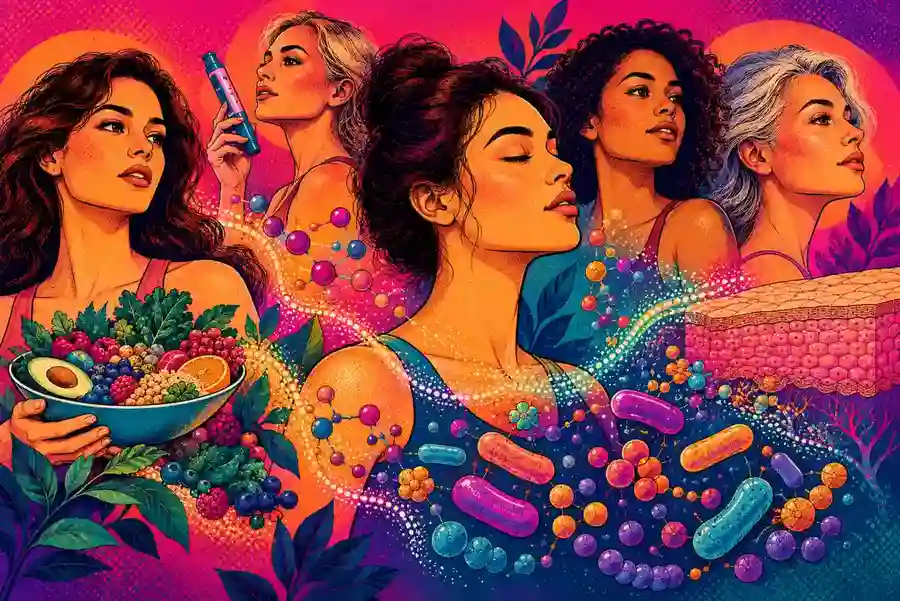
Food may help cultivate the gut environment. That environment may influence Akkermansia. Akkermansia may influence GLP-1. And somewhere further along that biological conversation sits another organ: our skin.
And this is where the pieces become particularly intriguing.
In Part I, we saw emerging evidence that GLP-1 signaling may reach skin biology directly.
In Part II, we have followed GLP-1 back to the gut — and found that its natural release may be influenced by food and by the microorganisms living there.[1,2]
And we already know that the gut itself communicates with the skin through what researchers call the gut–skin axis.[8]
Suddenly, these are no longer three completely separate stories.
Food. The gut microbiome. GLP-1. The skin.
They may be different parts of a biological chain that science has only begun to piece together.
We have already seen that GLP-1 therapy may change the gut microbiome.[4]
We may therefore be looking at two different routes to the same destination.
One begins with GLP-1 medication.
The other begins with food.
Both meet in the gut. And both may continue from there to the skin through the gut–skin axis.[8]
That may be the most important clue from Part II: what happens to our skin — with or without GLP-1 therapy — may depend in part on the gut environment we cultivate through what we eat. And when we do begin GLP-1 therapy, we bring that biological environment with us.